

The investment story around parking is changing. The traditional view focused on bays, tariffs and occupancy. A broader view asks a different question: what essential access function does this site perform within the surrounding city?
That shift matters in Australia, where private vehicles remain deeply embedded in passenger movement while cities continue to invest in public transport, housing, health and energy infrastructure. It does not make every car park an infrastructure-quality asset. It does, however, explain why strategically located parking is increasingly analysed alongside other forms of operational real estate and mobility infrastructure.
From a parking product to an infrastructure lens
Infrastructure is usually associated with large public systems: roads, rail, airports, hospitals, energy networks and utilities. Parking is smaller in scale, but selected assets can share several infrastructure-like characteristics.
They occupy fixed locations, serve identifiable catchments and require ongoing operation. Their usefulness is tied to the activity around them. A facility beside a hospital, airport, university or dense business district may support access to a wider economic or social destination rather than operate as an isolated retail product.
It is “What movement, destination and activity does this location enable?”
This perspective places greater weight on connectivity, access rights, surrounding land uses, operating systems and the capacity of a site to remain useful as transport behaviour evolves.
Location is the source of the infrastructure story
A parking structure does not create durable relevance by itself. Its position within an urban network does. The strongest locations tend to sit near destinations where access is valuable, space is constrained and demand is generated by more than one user group.
Examples may include hospital precincts with staff, visitors and patients; airports with passengers and workers; commercial centres with office, retail and service demand; and mixed-use districts operating beyond a single nine-to-five cycle.
Australian transport data provides useful context. The Bureau of Infrastructure and Transport Research Economics reported that cars accounted for 166 billion passenger-kilometres on capital-city roads in 2024–25. At the same time, Infrastructure Australia identifies growing congestion and freight movement as constraints on urban road networks. Together, these points suggest a more nuanced future: private vehicles remain significant, but access must be managed within cities where road and land capacity are finite.
For parking property analysis, this means broad traffic numbers are not enough. Catchment quality, competing supply, public-transport alternatives, future development and the specific reasons people travel to the location all need to be considered.

The physical and operational layers
Infrastructure becomes useful through operation. Parking is no exception. The building provides physical capacity, but performance also depends on pricing, access control, payment technology, maintenance, safety, wayfinding, customer service and reporting.
This operating layer can support better pricing, maintenance planning and site management. Weak execution can instead create downtime, leakage, customer friction or reputational damage.
A professional review should therefore examine responsibilities, performance standards, system resilience, fees and reporting rights—not headline occupancy alone.
EV charging is expanding the role of parking property
Australia’s transition to electric vehicles adds another layer to the parking infrastructure discussion. The Australian Government’s National Electric Vehicle Strategy supports the rollout of charging infrastructure, while changes to the National Construction Code are intended to help new buildings accommodate future EV charging.
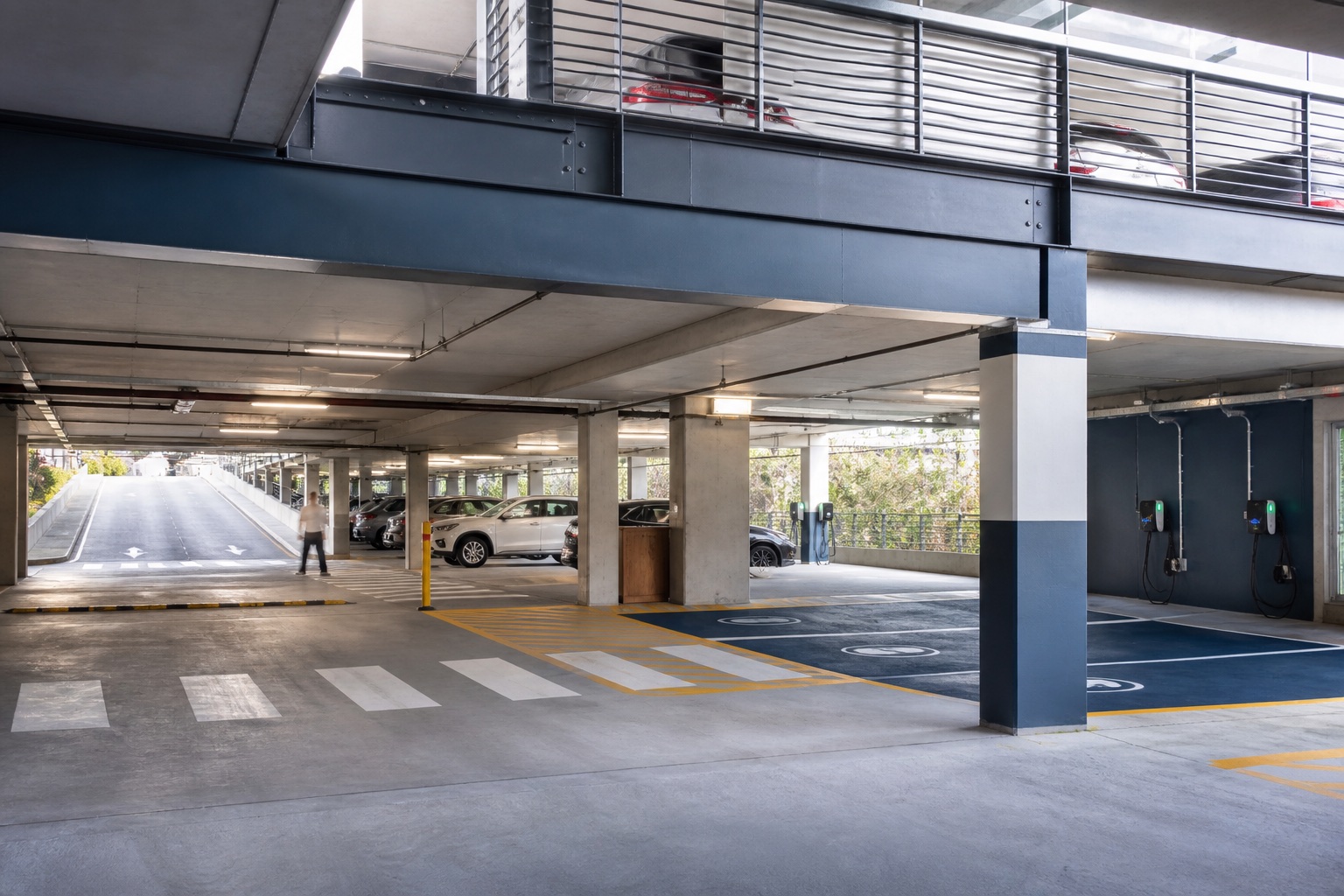
Parking sites are natural dwell locations. That can make selected facilities relevant to destination charging and fleet use, but the opportunity is not automatic. Electrical capacity, connection cost, building requirements, charging duration and utilisation all affect feasibility.
The credible infrastructure story is about practical adaptability—not the assumption that every trend will generate additional income.
What the infrastructure story does—and does not—mean
Describing parking as infrastructure does not remove property or operating risk. It is not a guarantee of occupancy, income, asset value or liquidity. A poorly located or poorly governed facility remains exposed regardless of the label applied to it.
Demand may change with new transport links, remote-work patterns, competing developments, planning policy or major tenants. Older structures can require substantial capital expenditure. Operator contracts may underperform. EV infrastructure can add cost before it adds utility. Property rights, leases and access arrangements can restrict future options.
The quality of the story depends on evidence: the location, legal rights, physical condition, demand sources, operating arrangements, cost base and adaptability of the specific asset.
This distinction is important for anyone researching parking infrastructure investment in Australia. The useful question is not whether parking belongs to a fashionable asset class. It is whether the individual property performs a defensible urban function on commercially workable terms.
Six questions for assessing a parking infrastructure story
- 01Which destination does the site serve?
Identify the reasons people travel there and whether demand comes from one source or several.
- 02What rights support operation?
Confirm ownership, lease, licence, access and use rights, together with their duration and constraints.
- 03How resilient is local demand?
Consider competing supply, public transport, development pipelines and changes in surrounding land use.
- 04Who controls operating performance?
Understand the operator, technology stack, service standards, fees, reporting and replacement provisions.
- 05What capital work may be required?
Review structure, equipment, safety systems, accessibility, maintenance and electrical capacity.
- 06Can the site adapt?
Test the practical potential for EV charging, mobility services or future alternative uses without assuming they will occur.
Parking is becoming an infrastructure investment story because selected assets connect scarce urban land with recurring access needs and an expanding range of mobility services. In Australia, the most compelling examples will be those where that narrative is supported by location evidence, disciplined operations and realistic plans for adaptation.
Sources and further reading
- BITRE — Australian Infrastructure and Transport Statistics Yearbook 2025
- Infrastructure Australia — 2025 Infrastructure Market Capacity Report
- Infrastructure Australia — 2026 Infrastructure Priority List
- Australian Government — National Electric Vehicle Strategy
Published for general information only. It is not investment, legal, valuation, tax or property advice. Outcomes depend on the specific asset, rights, contracts and market conditions.